
Becoming a pilot is one of the most prestigious career choices in the world. But when it comes to pilot training, aspiring aviators often find themselves confused between two key licenses: the Commercial Pilot License (CPL) and the Private Pilot License (PPL).
Although both involve flying aircraft, the scope, career opportunities, training requirements, and eligibility criteria differ significantly. In this blog, we will explore the differences between CPL and PPL in detail, compare them through tables, charts, and examples, and help you decide which license is the right choice for your aviation journey.
What is a Private Pilot License (PPL)?
A Private Pilot License (PPL) is the most basic type of pilot license. It allows you to fly an aircraft for personal or recreational purposes, but not for commercial gain.
It is ideal for:
- Aviation enthusiasts who want to fly as a hobby.
- Individuals who want to own private aircraft.
- Those who want an entry point before pursuing a CPL.
What is a Commercial Pilot License (CPL)?
A Commercial Pilot License (CPL) is a professional license that allows you to fly aircraft as a paid pilot. With a CPL, you can work with airlines, charter companies, cargo services, or corporate jets.
It is ideal for:
- Students who want to become professional airline pilots.
- Individuals aiming for a long-term aviation career.
- Those seeking global opportunities in the aviation industry.
Key Differences Between CPL and PPL
Here’s a detailed comparison of CPL vs PPL:
| Factor | Private Pilot License (PPL) | Commercial Pilot License (CPL) |
| Purpose | For hobby, leisure, or private flying | For professional, paid flying jobs |
| Career Opportunities | No earning allowed | Airline pilot, charter pilot, cargo pilot |
| Minimum Age | 17 years | 18 years |
| Medical Fitness | Class 2 Medical Certificate | Class 1 Medical Certificate |
| Training Duration | 6–12 months | 18–24 months |
| Flight Hours Required | 40–60 hours | 200 hours (minimum) |
| Exams | Basic DGCA theory exams | DGCA Commercial Pilot exams (Navigation, Meteorology, Air Regulations, etc.) |
| Cost of Training | ₹10–15 Lakhs | ₹35–55 Lakhs |
| Salary | Not applicable | ₹3–12 LPA (starting, can go up to ₹40–50 LPA with experience) |
Training Requirements
Below is a quick visual breakdown of training hours:
PPL: 40–60 Hours
CPL: 200 Hours
- PPL requires basic flight exposure.
- CPL demands extensive training including cross-country flying, instrument flying, and night flying.
Eligibility Criteria for CPL vs PPL
PPL Eligibility:
- Minimum age: 17 years
- Passed 10th standard (some schools ask for 12th with Physics & Math)
- DGCA Class 2 Medical Certificate
- Basic English proficiency
CPL Eligibility:
- Minimum age: 18 years
- 10+2 with Physics & Mathematics (mandatory)
- DGCA Class 1 Medical Certificate
- Strong English communication skills
- Minimum 200 flying hours training
Career Scope
After PPL:
- Fly for personal use or as a hobby
- Cannot earn money from flying
- Can pursue further training to upgrade to CPL
After CPL:
- Eligible to become an airline pilot
- Opportunities in cargo, charter, corporate flying
- Pathway to become a Captain, Flight Instructor, or Airline Training Pilot
Cost Comparison
| Expense | PPL | CPL |
| Ground Training | ₹1–2 Lakhs | ₹5–7 Lakhs |
| Flying Training | ₹8–12 Lakhs | ₹30–45 Lakhs |
| Medicals & Exams | ₹50,000 | ₹2–3 Lakhs |
| Total Cost | ₹10–15 Lakhs | ₹35–55 Lakhs |
Clearly, CPL training is a bigger investment but offers high-paying career opportunities, whereas PPL is more affordable but limited in scope.
Which One Should You Choose – CPL or PPL?
The choice between a CPL and a PPL depends on your career goals:
- ✅ Choose PPL if you want to fly recreationally, own a private aircraft, or take the first step toward aviation without committing to a professional career immediately.
- ✅ Choose CPL if you want to become a professional pilot, join airlines, and make flying your full-time career.
Career Growth Path with CPL
Here’s how a CPL holder’s career can grow over time:
- First Officer (Airline Entry-Level) → Salary: ₹3–5 LPA
- Senior First Officer → Salary: ₹7–12 LPA
- Captain → Salary: ₹20–35 LPA
- Type Rated Captain on Wide-Body Aircraft → Salary: ₹40–50 LPA
Whereas PPL holders do not have a career ladder since it is for personal use.
Infographic-Style Summary
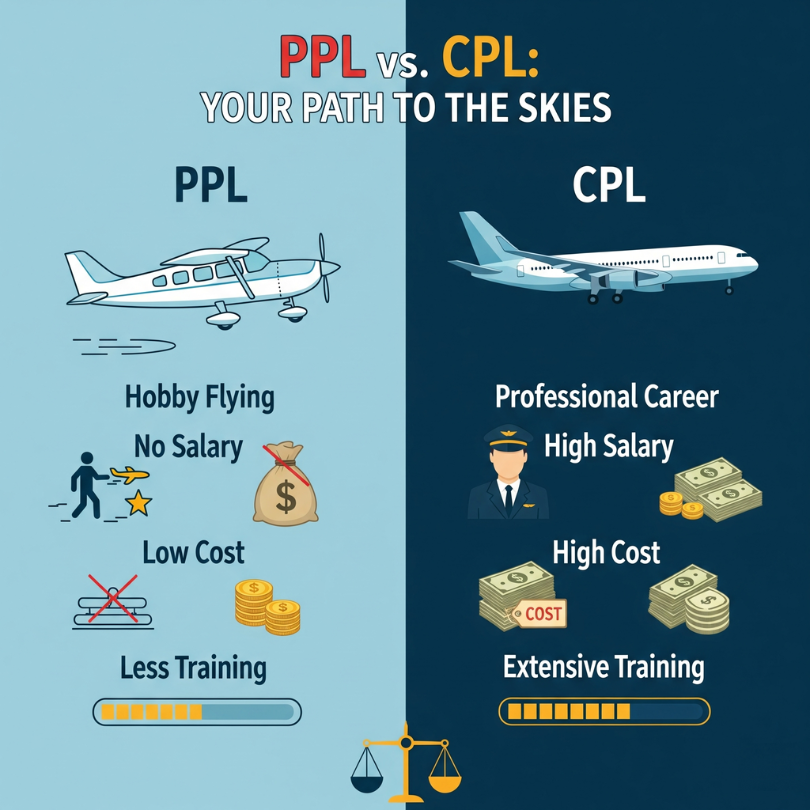
PPL → Hobby Flying → No Salary → Low Cost → Less Training
CPL → Professional Career → High Salary → High Cost → Extensive Training
Conclusion
The difference between Commercial Pilot License (CPL) and Private Pilot License (PPL) lies in their purpose, scope, cost, and opportunities. If your goal is a career in aviation, CPL is the gateway to professional flying. But if you just want to enjoy the freedom of flying as a hobby, PPL is the perfect choice.
At TOP Crew Aviation Academy, we guide aspiring pilots through both PPL and CPL training with world-class instructors, modern aircraft, and international-standard facilities. Whether you dream of becoming a professional airline pilot or just flying for fun, the right license will shape your aviation journey.